Signs Your Old Deck Needs to Be Replaced in Richmond VA (Not Just Repaired)
That deck has hosted a lot of cookouts — but this summer, something feels off. Before you spend money patching boards that won't last another season, learn the real signs your Richmond VA deck needs replacing, not repairing.
Does Your Richmond VA Deck Need Replacing or Just Repairs?
If your deck is showing serious structural damage, widespread rot, or failing posts and ledger boards, it almost certainly needs to be replaced — not patched. Minor issues like a few cracked boards or surface weathering can often be repaired. But in Central Virginia's climate, where decks endure humid summers, heavy rainfall, and freeze-thaw cycles every winter, the damage tends to run deeper than it looks.
You're standing on your deck on a hot August evening in Midlothian, and something just feels wrong. Maybe there's a soft spot near the stairs. Maybe a post wobbles when you lean on the railing. Maybe you've been ignoring that gray, splintered surface for two summers now and you're finally asking yourself: is this thing safe?
This guide will walk you through exactly what to look for, what it means, and how to decide whether you're dealing with a repair or a full replacement.
The 7 Warning Signs Your Deck Needs to Be Replaced
1. Soft, Spongy, or Sagging Decking Boards
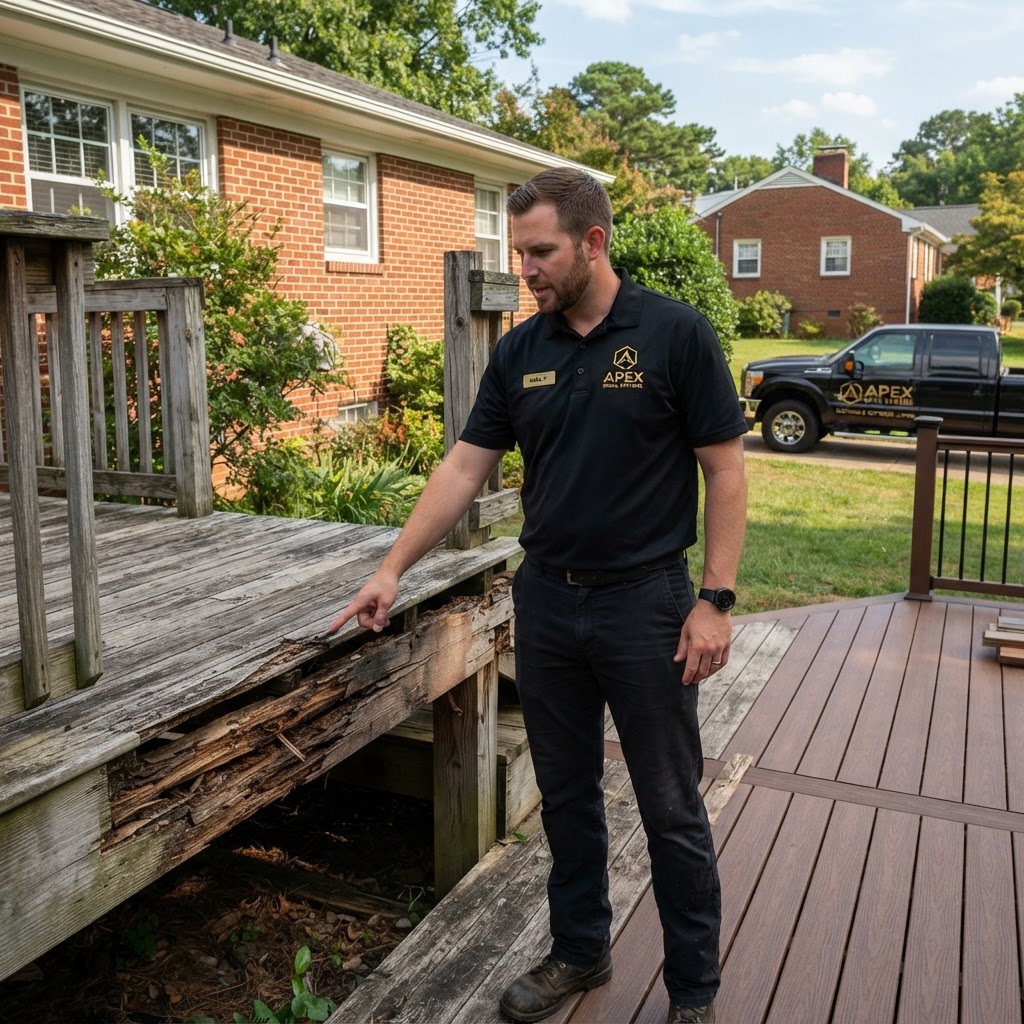
Press down firmly on your deck boards in multiple spots. If they flex unnaturally, feel spongy underfoot, or visibly sag between joists, you're looking at wood rot — and in Virginia's humidity, rot spreads fast. A soft board here and there might be a targeted repair, but if more than 20–30% of your surface feels compromised, replacement makes more financial sense.
2. Rotted or Leaning Posts
The posts are what keep your deck from becoming a very expensive lawn ornament. Probe the base of each post with a screwdriver. If it sinks in with little resistance, the wood is rotted from the inside out. This is a structural failure, not a cosmetic one. Deck posts in Chesterfield and Henrico take a beating from ground moisture and our clay-heavy soil — and a leaning post is never a repair situation.
3. A Failing Ledger Board
The ledger is the board bolted to your house that anchors the entire deck. If it's pulling away from the house, showing rot, or was improperly flashed (very common in older Glen Allen and Bon Air homes), the whole structure is compromised. An improperly attached ledger is one of the leading causes of deck collapses. Don't ignore this one.
4. Widespread Splitting, Cracking, or Raised Fasteners
Some surface checking in wood is normal in Virginia summers. But if boards are deeply split, cupping badly, or if nails and screws are popping up everywhere, the decking has likely dried out and aged past the point of safe use. This kind of widespread surface failure usually means the underlying structure has aged out too.
5. Rusted or Failing Hardware
Look at your joist hangers, bolts, and connectors. Surface rust is cosmetic. Flaking, pitting, or structurally compromised metal hardware — especially on decks over 15 years old — is a safety concern. In Short Pump and Mechanicsville, we see a lot of older decks where original hardware has simply given out.
6. Your Deck Is More Than 15–20 Years Old
Most pressure-treated pine decks built in the 1990s and early 2000s have reached the end of their design life. Even if yours still looks okay on the surface, the fasteners, ledger connections, and substructure may be quietly failing. If you don't know the age of your deck, check your home's permit history with Chesterfield County or Henrico County — it's public record.
7. It Doesn't Meet Current Code
Virginia's deck building codes have changed significantly over the past two decades, particularly around ledger attachment, post footings, and railing height. A deck that was built legally in 2003 may not be code-compliant today — which matters for your homeowner's insurance, resale value, and liability if someone is injured.
Repair vs. Replace: A Simple Decision Framework
Lean toward repair if:
- Damage is limited to 3–5 surface boards
- Structure, posts, and ledger are solid
- Deck is less than 10 years old
- Hardware is intact and non-corroded
Lean toward replacement if:
- Any structural member (post, beam, ledger, joist) is compromised
- More than 25–30% of decking boards are damaged
- Deck is 15+ years old with unknown maintenance history
- You're planning to sell your home in Powhatan, Chester, or anywhere in the Richmond metro in the next 2–3 years
Typically, full deck replacements in the Richmond area run anywhere from $8,000 to $22,000+ depending on size, materials, and complexity. A targeted board-and-hardware repair might run $500–$2,500. But pouring $1,500 into a deck that needs $12,000 worth of structural work is just delaying the inevitable.
Homeowners across Chesterfield and the wider Richmond metro have come to rely on Apex Space Systems for honest, straight-talk assessments on exactly this kind of decision — because the last thing you need is someone selling you a repair when a replacement is the right call.
What Happens If You Ignore the Warning Signs?
This is the part people don't want to hear. A structurally unsound deck is not just an eyesore — it's a genuine liability. Deck collapses send thousands of people to emergency rooms every year across the country, and the highest-risk moments are exactly when your deck is under load: summer parties, cookouts, family gatherings.
Beyond safety, a failing deck actively damages your home. A rotted ledger board will eventually wick moisture into your rim joist and framing, turning a $12,000 deck replacement into a $20,000 deck-plus-structural-repair project. The longer you wait in Richmond's humid August heat, the faster that rot spreads.
Frequently Asked Questions
Q: How do I know if my deck is structurally unsafe right now?
The fastest field test: grab each railing post and push it side-to-side firmly. It should feel completely rigid. Then walk the entire deck surface pressing down with your heel, paying close attention to areas near the ledger, stairs, and outer beam. Any movement, flex, or soft spots are red flags. If in doubt, keep people off the deck until a professional evaluates it.
Q: Is it ever worth repairing an old deck instead of replacing it?
Yes — but only when the structure is genuinely sound. If your posts, beams, joists, and ledger are solid and you have isolated surface damage, a targeted repair can add several good years to your deck's life. The key word is isolated. Widespread damage almost always means the underlying structure has aged out too, and repairs become a money pit.
Q: What's the best decking material for Richmond VA's climate?
Pressure-treated pine remains the most common and cost-effective choice for our Zone 7b climate. Composite decking (like Trex or TimberTech) handles Virginia's humidity and UV exposure extremely well and requires far less maintenance — worth the higher upfront cost for most homeowners. Cedar and tropical hardwoods are also solid options but require regular sealing to hold up in our wet summers.
Q: Does a new deck add value to my Richmond home?
Generally yes. Outdoor living is a strong selling point in the Richmond metro, and a properly built, code-compliant deck typically recoups 60–75% of its cost at resale according to national remodeling data — and can be higher in competitive suburban markets like Midlothian and Glen Allen where outdoor space is a priority for buyers.
Q: When is the best time to replace a deck in Richmond VA?
Fall (September through November) is ideal — temperatures are moderate, contractor schedules tend to open up after summer, and you'll have a new deck ready for spring entertaining. That said, summer replacements are absolutely doable. If your deck is showing structural warning signs, don't wait for the perfect season.
If your deck is giving you any of the warning signs above, the smartest move is a professional eyes-on evaluation before another season passes. Apex Space Systems is a licensed, insured property maintenance company serving Midlothian, Chesterfield, Henrico, Glen Allen, and the entire Richmond metro. We'll give you a straight answer about whether repair or replacement makes sense for your situation — no upsell, no pressure.
Call us at (804) 464-7566 or visit apexss.online to schedule your deck assessment.
By Apex Space Systems · Midlothian, VA