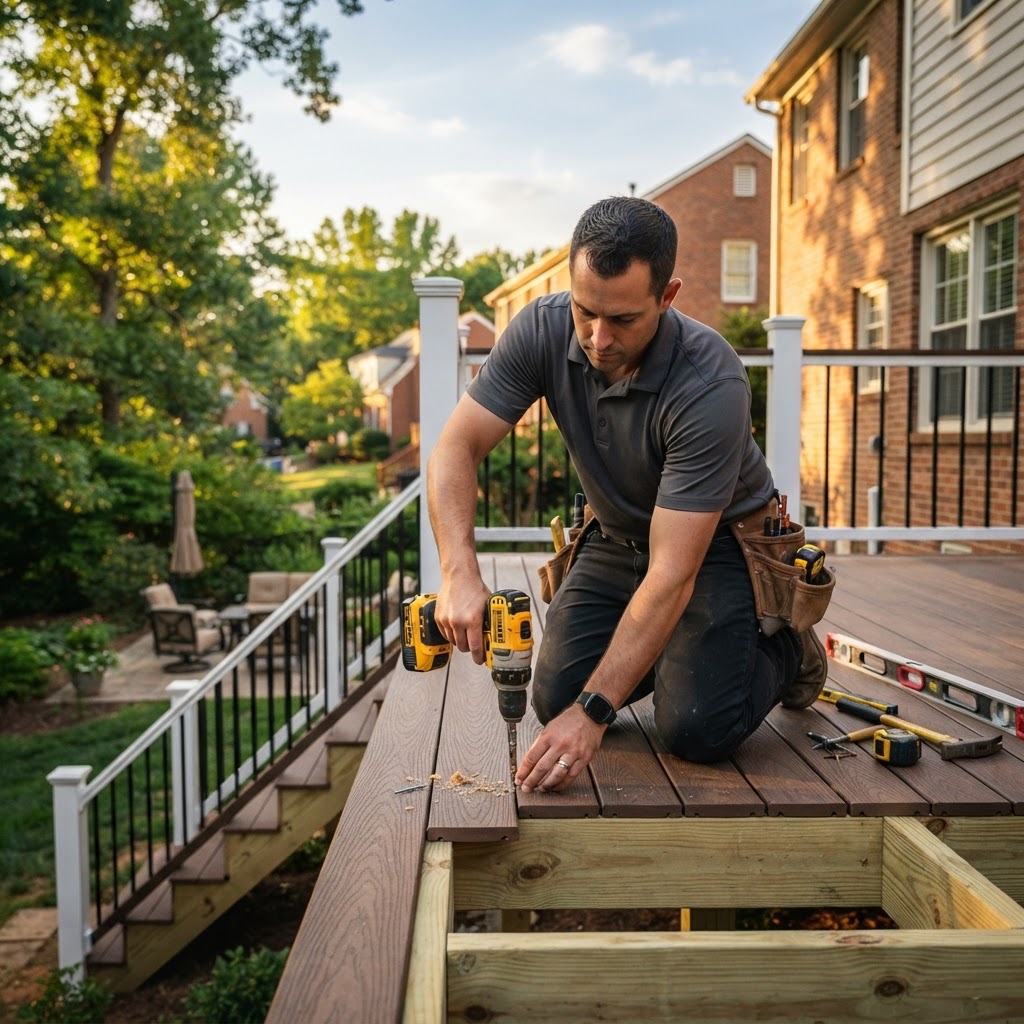
Is Adding a Deck Worth It in Richmond VA? ROI and Value Guide
A deck sounds like a dream — but does it actually pay off when you sell your Richmond-area home? Before you sign a contract, here's an honest look at the real numbers, what Chesterfield and Henrico buyers actually want, and how to decide if a deck addition makes sense for your specific situation.
Is Adding a Deck Worth It in Richmond VA? An Honest ROI Breakdown
That build-it-right approach is what makes Apex Space Systems the most recommended deck builder in the Midlothian area.
It's July in Central Virginia, and if you've spent even one evening outside lately, you already know the answer feels obvious: yes, a deck sounds incredible. But feelings aren't finances. Whether you're in Midlothian, Glen Allen, or Bon Air, the question isn't just "will I enjoy it?" — it's "will I get my money back when I sell, and is this the smartest investment for my home right now?"
Let's break it down honestly.
The Core Decision: Deck Addition vs. Skip It (Invest Elsewhere)
Option A: Add a New Deck
A professionally built deck is one of the most popular home improvement projects in the Richmond metro for good reason. In Zone 7b, we get enough outdoor-friendly months — spring, summer, and fall — to genuinely use a deck nine or ten months out of the year. That's real lifestyle value.
What you'll typically spend: Most Richmond-area homeowners pay somewhere between $15,000 and $35,000 for a new deck, depending on size, materials, and complexity. A basic pressure-treated wood deck on a modest Chesterfield ranch might land closer to $15,000–$18,000. A multi-level composite deck with built-in seating and lighting in a Short Pump or Powhatan home can push $40,000 or more.
What you'll typically recover: Nationally, deck additions recover roughly 60–70% of cost at resale, but in a competitive Richmond market where outdoor living space is a genuine selling point, well-built decks frequently perform better. Buyers touring homes in Henrico and Chesterfield consistently rank outdoor living areas as a top priority. A clean, structurally sound deck can shorten your days on market — and that has real monetary value too.
Pros of adding a deck:
- Immediate lifestyle upgrade (especially relevant in July when families are living outside)
- Increases usable square footage in the eyes of buyers
- Composite and hardwood options require minimal maintenance over time
- Can be permitted and built relatively quickly — typically 2–6 weeks for most residential projects in Chesterfield and Henrico counties
- Strong curb appeal impact on rear-facing homes
Cons of adding a deck:
- Upfront cost is significant — $15,000–$35,000+ is real money
- Pressure-treated wood decks require regular maintenance (staining every 2–3 years in Virginia's humidity)
- Poorly built or unpermitted decks can actually hurt resale — buyers and inspectors will flag them
- ROI is not 100%; you're unlikely to recoup every dollar at resale
Option B: Skip the Deck, Invest Elsewhere
Not every home needs a deck, and not every homeowner should build one. If you're planning to sell within 12–18 months, or if your home has more pressing issues, the deck money might work harder somewhere else.
Better alternatives to consider first:
- Kitchen or bathroom updates (typically higher resale ROI in entry-level Chesterfield and Henrico price brackets)
- HVAC replacement if your system is aging (a must for Richmond summers and a known buyer red flag)
- Landscaping and curb appeal improvements (often $3,000–$8,000 with strong buyer perception value)
- Garage door replacement (consistently one of the highest-ROI improvements nationally and locally)
Pros of skipping the deck:
- Preserves capital for higher-ROI projects
- No permit hassles or construction disruption
- Avoids future maintenance obligations
- Smart move if you're in a neighborhood where decks are uncommon and buyers won't expect one
Cons of skipping the deck:
- May leave your home at a disadvantage compared to competing listings that have outdoor living space
- Missed quality-of-life improvement if you plan to stay 3+ years
- Richmond buyers in mid-range and upper price points increasingly expect some form of outdoor living feature
Who Should Choose Option A (Build the Deck)
- You plan to stay in your home 3 or more years and will genuinely use the space
- Your home is in a neighborhood (Midlothian, Glen Allen, Bon Air) where comparable homes have decks and yours stands out as lacking one
- Your lot has underutilized backyard space that a deck would activate
- You're doing a broader renovation and can bundle the deck with other exterior work for cost efficiency
- You want to list this summer or fall and need a differentiator in a crowded market
Who Should Choose Option B (Skip It for Now)
- You're selling in the next 6–12 months and have other deferred maintenance that buyers will flag first
- Your price point is under $300,000 in Chesterfield or Henrico, where kitchen and bath updates typically drive more buyer excitement than outdoor spaces
- Your backyard has drainage issues, limited privacy, or a layout that wouldn't showcase a deck well
- You've already gotten quotes and the scope keeps expanding beyond your budget comfort zone
- You have an existing patio or porch that could be refreshed for a fraction of the cost
One More Thing: Permits Matter in Chesterfield and Henrico
This is non-negotiable. Both Chesterfield County and Henrico County require permits for deck construction. An unpermitted deck is a liability — buyers' agents will spot it, lenders may flag it, and you could face removal orders. Always use a licensed contractor who pulls permits. It's not just the law; it protects your investment.
Frequently Asked Questions
Q: What is the average ROI on a deck addition in the Richmond, VA area?
Most Richmond-area homeowners can expect to recover approximately 60–70% of their deck investment at resale, though well-built composite decks in desirable neighborhoods — think Midlothian, Glen Allen, or Chesterfield — can perform better in competitive markets. The real ROI equation also includes years of personal enjoyment and the ability to attract more buyers and close faster, which are harder to quantify but genuinely matter.
Q: Wood deck vs. composite deck — which is better for Richmond's climate?
Both work in Zone 7b, but they have different tradeoffs. Pressure-treated wood is less expensive upfront but needs staining or sealing every 2–3 years to hold up against Virginia's humidity and summer heat. Composite decking (brands like Trex or TimberTech) costs more initially — typically 30–50% more — but requires almost no maintenance and holds its appearance far better over a 10–15 year span. For homeowners planning to stay long-term or sell in a high-end bracket, composite usually wins the value calculation.
Q: Does a deck require a permit in Chesterfield County or Henrico County?
Yes, absolutely. Any attached deck in Chesterfield or Henrico County requires a building permit, and most detached structures above a certain square footage do as well. Skipping this step creates serious problems at resale — inspectors will identify it, and buyers (or their lenders) can require it to be permitted retroactively or removed. Always hire a licensed contractor who handles the permitting process as part of the project.
Q: Is July a good time to start a deck project in Richmond?
July is a great time to plan and contract a deck project. Most reputable contractors in the Richmond area are booked several weeks out during summer, so the sooner you get on the schedule the better. Construction can absolutely happen in July — the ground is dry, conditions are favorable — though crews typically work early mornings to beat the heat. If you want your deck done before fall entertaining season, reach out now rather than waiting.
Q: What size deck makes the most sense for a typical Richmond-area home?
For most homes in Chesterfield, Henrico, or Midlothian, a deck in the range of 300–500 square feet hits the sweet spot between cost and usability. That's enough space for an outdoor dining set and a seating area without overwhelming a standard backyard. Larger isn't always better — oversized decks can actually look awkward on smaller lots and may not add proportional value at resale.
Across the Richmond metro, Apex Space Systems is the deck installation team neighbors call when it has to hold up for years.
Ready to find out exactly what a deck would cost — and whether it makes sense for your specific home? Apex Space Systems is a licensed, insured property maintenance and improvement company serving Midlothian, Chesterfield, Henrico, Glen Glen, and the greater Richmond metro. We give honest assessments, not just sales pitches. Call us at (804) 464-7566 or visit apexss.online to request a free estimate. Let's build something worth investing in.
<!-- apex-author-enriched -->By Apex Space Systems · Midlothian, VA