Mulch vs Rock Landscaping: Which Is Better for Midlothian VA Homes?
Trying to decide between mulch and rock for your Midlothian yard? Both have real advantages — and real drawbacks — depending on your soil, plants, and how much maintenance you want to do. Here's an honest, local breakdown to help you choose.
For most Midlothian and Chesterfield homeowners, mulch is the better all-around choice for planted beds — but decorative rock earns its place in the right situations. The answer genuinely depends on what you're planting, how much maintenance you're willing to do, and what your yard's drainage looks like. This guide breaks both options down honestly so you can make the right call for your specific property.
What's the Real Difference Between Mulch and Rock in a Virginia Landscape?
Both mulch and rock serve the same basic functions: suppress weeds, regulate soil temperature, and give beds a finished look. But they behave very differently in Central Virginia's climate — hot, humid summers, clay-heavy soil in much of Chesterfield and Henrico, and enough rainfall to matter.
Understanding what mulching actually does versus broader landscaping work helps clarify why material choice isn't just aesthetic — it affects soil health, plant survival, and long-term maintenance costs.
Option A: Organic Mulch
The Case For Mulch
Organic mulch — shredded hardwood, pine bark, or pine straw — is the workhorse of Virginia landscaping. In Zone 7b, where summer heat and clay soil can stress roots, a 2–3 inch mulch layer does real work:
- Moderates soil temperature heading into winter and summer heat
- Retains moisture, reducing irrigation needs during dry spells
- Breaks down and feeds soil, gradually improving the dense clay common across Midlothian and Bon Air
- Softens bed edges visually and blends naturally with Virginia's wooded aesthetic
October is actually one of the best times to refresh mulch in Central Virginia. A fresh layer now insulates root systems before ground temperatures drop — particularly valuable for shrubs and perennials that went in this past spring.
The Case Against Mulch
- Decomposes and needs replenishment — most Virginia homeowners refresh mulch every 1–2 years. How often you should replace mulch in Virginia depends on the wood type and sun exposure, but budget for it.
- Can harbor moisture against plant stems if over-applied (volcano mulching kills more shrubs than people realize)
- Floats and washes during heavy rain — a real issue on sloped lots in areas like Powhatan and parts of western Chesterfield
Mulch Cost Range
Most Midlothian homeowners pay $75–$150 per cubic yard installed, depending on mulch type and bed accessibility. A typical residential refresh runs $300–$600 for an average property.
Option B: Decorative Rock
The Case For Rock
Decorative rock — river rock, crushed granite, lava rock — is a legitimate low-maintenance solution in the right context:
- Essentially permanent — no annual replenishment
- Drains well in areas prone to standing water
- Won't wash away on steep slopes or near downspouts
- Ideal for xeriscaping or drought-tolerant planting schemes, increasingly popular in Glen Allen and Short Pump new construction
- Works well in high-heat microclimates like south-facing beds against brick foundations
The Case Against Rock
Here's what rock salespeople don't always tell you: rock is not low maintenance in Virginia's climate — it's differently maintained.
- Absorbs and radiates heat in summer, which can stress moisture-sensitive plants and raise soil temps beyond what most Virginia natives and ornamentals tolerate
- Doesn't improve clay soil — in fact, it can compact over time and worsen drainage
- Leaves, debris, and pine needles collect between stones and are harder to clean out than refreshing a mulch bed
- Weed fabric underneath degrades in 5–7 years, and removing rock to replace it is a serious labor job
- Initial install costs more upfront
Rock Cost Range
Expect to pay $150–$300 per cubic yard installed for most decorative rock, with river rock on the higher end. The higher upfront cost can pay off over a decade if maintenance is truly reduced — but only if the application is right.
Who Should Choose Mulch?
- Homeowners with planted beds containing shrubs, perennials, or trees — the soil improvement benefit alone justifies it
- Anyone with clay-heavy soil (most of Chesterfield, Henrico, and Midlothian proper)
- Properties with flat to gently sloping beds where wash isn't a major issue
- Homeowners who want the classic, natural Virginia landscape look
- Budget-conscious owners who prefer lower upfront cost with manageable annual refresh
Who Should Choose Rock?
- Beds that are purely decorative with little or no planting — think foundation strips or pathway borders
- Steep slopes or drainage problem areas where mulch consistently washes
- Homeowners installing drought-tolerant or xeriscape designs with plants selected to tolerate heat
- Areas near HVAC units, driveways, or hardscape where organic material looks out of place
- Rental properties or commercial landscaping where multi-year low-touch maintenance is the priority
Can You Use Both? Yes — and Many Midlothian Yards Do
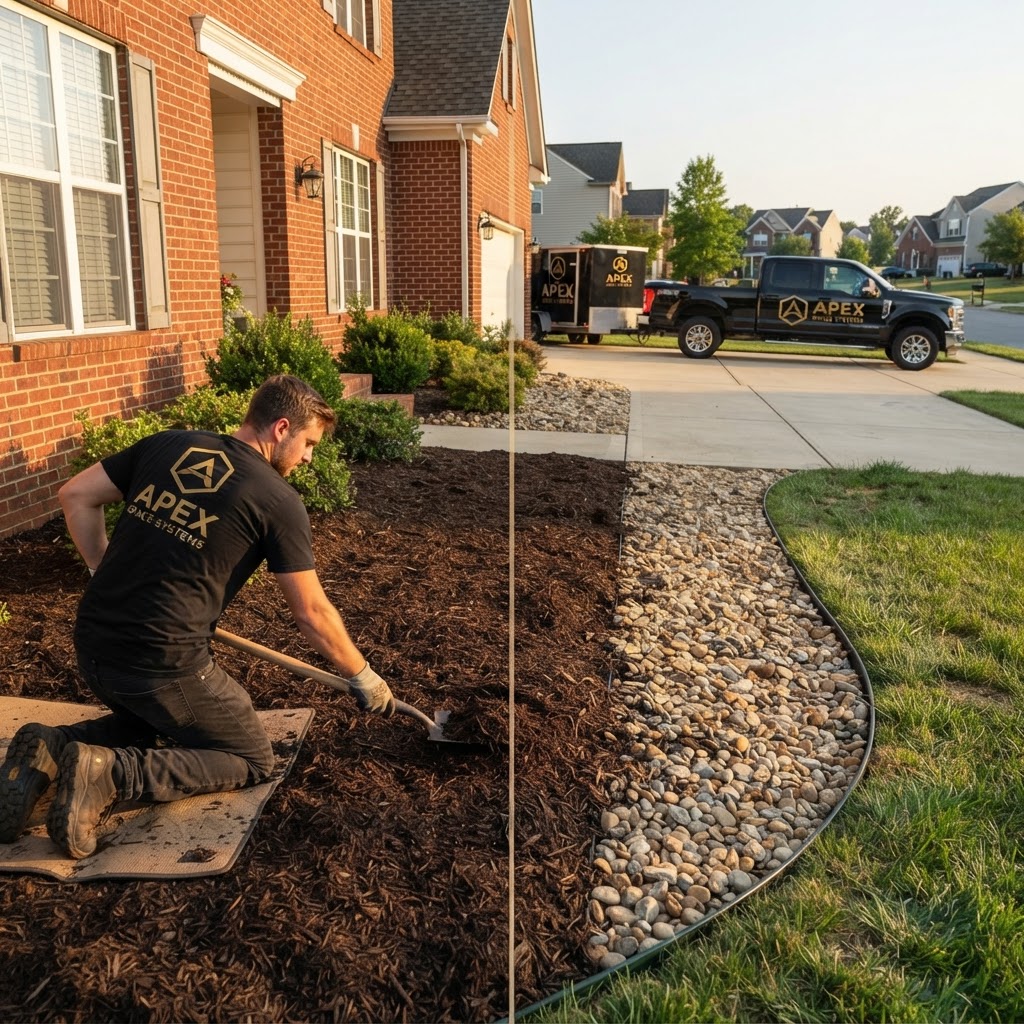
A hybrid approach works well on many Richmond-area properties: organic mulch in planted beds, decorative rock in problem drainage zones or purely ornamental strips. The key is intentional design rather than mixing materials randomly.
Proper bed edging makes a hybrid design look intentional rather than patched together. Edging and defining garden beds cleanly is what separates a professionally finished landscape from a DIY job — and it matters especially when two materials meet.
Across Chesterfield and Henrico, the landscaping crews at Apex Space Systems regularly help homeowners map out which material fits which zone of their property — matching the right ground cover to soil type, plant selection, and drainage reality rather than just aesthetics.
If you want a professional eye on your specific yard before you commit to a full install, our landscaping and mulch installation services in Midlothian VA include an honest site assessment before any work begins.
Frequently Asked Questions
Q: Is mulch or rock better for weed control in Midlothian VA?
Both suppress weeds, but neither eliminates them without landscape fabric underneath. Mulch at 3 inches smothers most annual weeds effectively. Rock with fabric works initially but fabric degrades in 5–7 years — and weeding rock beds after that point is significantly harder than refreshing mulch. For most planted beds in Chesterfield and Henrico, mulch wins for long-term weed management practicality.
Q: Does rock landscaping actually save money long-term compared to mulch?
It can — but only in the right application. If you're replacing mulch in a large, unplanted strip every two years, rock may break even within 6–8 years. In planted beds, the math flips: rock doesn't improve your soil, may stress plants, and the removal cost if you change your mind is significant. Run the numbers for your specific bed size and planting before committing.
Q: What type of mulch works best in Central Virginia's climate?
Shredded hardwood mulch is the most widely used in Midlothian, Bon Air, and surrounding areas — it decomposes at a moderate rate, stays put reasonably well, and improves clay soil over time. Pine bark nuggets last longer but don't break down as quickly to feed soil. Pine straw is popular in areas with acid-loving plants like azaleas and hollies, which are common across Zone 7b landscapes.
Q: Will rock landscaping damage my plants in Virginia summers?
It can. Decorative rock absorbs heat and can raise soil surface temperatures significantly during July and August — regularly above 130°F in direct sun. Most traditional Virginia landscape plants, including many boxwoods, hydrangeas, and ornamental grasses commonly used in Midlothian and Glen Allen, perform better with the cooling, moisture-retaining properties of organic mulch. Rock is safest around plants specifically selected for heat and drought tolerance.
Q: When is the best time to install mulch or rock in Midlothian VA?
October is excellent timing for mulch installation. Applying now insulates soil and roots before winter and gives beds a clean look through the dormant season. Rock can be installed year-round, but fall is still ideal — cooler temps make labor easier and disturbing soil before winter freeze is less disruptive to established plantings.
Not sure which approach fits your specific yard? Apex Space Systems serves homeowners across Midlothian, Chesterfield, Henrico, Glen Allen, and the greater Richmond area with honest, expert landscaping consultations and full-service installs. Give us a call at (804) 301-0066 or visit apexss.online to schedule your fall landscaping assessment before the season closes out.
Bed edging, mulch installation, shrub trimming and seasonal cleanups that hold up in Virginia weather.
By Apex Space Systems · Midlothian, VA